Bring back some good or bad memories


ADVERTISEMENT
Alaska etiketine sahip kayıtlar gösteriliyor. Tüm kayıtları göster

12 Temmuz 2023

In 1979, Gold Miners in Alaska Discovered a Well-Preserved Body of a Steppe Bison That Died 36,000 Years Ago!

Blue Babe is a perfectly preserved Steppe Bison, found completely by chance in Alaska in 1979. The animal died some 36,000 years ago, and was so well preserved that researchers were able to cook and eat a part of its neck muscle. The meat was described as “tough” and the taste “earthy and delicious.”


In 1979, gold miners near Fairbanks, Alaska uncovered the find of a lifetime. Buried in the frozen tundra wasn’t gold at all, but instead, a frozen and amazingly well-preserved animal from the last ice age. After excavation, the creature was studied at the University of Alaska, and at first, it was thought to be some 36,000 years old. More recent estimates, though, say the animal lived at least 55,000 years ago.

The animal that gold miners uncovered in 1979 and that is now on permanent display at the University of Alaska Museum of the North is an ice age steppe bison, and evidence suggests it was killed by the now-extinct Ice Age American lion, Panthera leoatrox. After it was excavated, a chalk-like blue substance was found on the animal — a byproduct of phosphorus from the animal tissue as it met iron in the soil — and for this reason, the creature was nicknamed “Blue Babe.”

Such finds of frozen animals from the last ice age are rare but not unheard of, and whenever they’re found, they provide an unparalleled glimpse back in history. In the case of the frozen ancient animal uncovered in Alaska, some wondered — what might the animal taste like, after thousands of years in a deep freeze? In 1984, one University of Alaska Fairbanks paleontologist, Dale Guthrie, decided he’d like to find out, and he invited some friends over to try to taste it with him.

The notion of tasting the meat — which likely froze quickly after the bison died — was not unique to the Alaskan researchers. Paleontologist Dale Guthrie told Atlas Obscura his team had heard about Russian scientists excavating bison and mammoth. Those finds were frozen enough to eat at the time of their discovery, just like Blue Babe, with textured muscle tissue, and preserved fat and bone marrow. “So we decided, ‘You know what we can do? Make a meal using this bison,’” Guthrie said.

The meal that Guthrie decided to make was a stew from a small bit of meat cut from Blue Babe’s neck. The meat, which had freeze-dried while still fresh, smelled faintly like beef once it had finally thawed out. According to Guthrie, it also had an earthy aroma mixed with the scent of mushrooms. The meat was then cooked with vegetables and spices with garlic, onion, and potatoes in a stew. About a dozen people attended the dinner party.

All told, the ancient meat stew tasted “okay” and nobody at the dinner party that night got sick from the Ice Age meal. As Guthrie said, “It tasted a little bit like what I would have expected, with a little bit of wring of mud ... But it wasn’t that bad. Not so bad that we couldn’t each have a bowl.” In 2021, Guthrie’s wife, Mary Guthrie who tasted the stew that night, appeared on the “Every Little Thing Podcast” and recalled her experience eating at least 50,000-year-old beef stew. “It was a good stew, and then we put the bison in,” she said.


18 Nisan 2022

Mug Shot of Steve McQueen in Anchorage, Alaska, 1972

In 1972, Steve McQueen was arrested for drunk driving in Anchorage, Alaska. According to witnesses, the movie star raced through town in a rented Oldsmobile Toronado. When Police finally managed to pull him over and perform a sobriety test, he failed by somersaulting down the white line, on which he was ordered to walk.

“McQueen was roaring up and down 4th Avenue at very high speed and turning brodies – drunker than hell,” said Lynn Burlingame, who was in Anchorage at the time. “It was not just a time or two – he really raised hell for quite a while. When they did finally get him stopped they administered a field sobriety test, and he somersaulted down the white line. Once they got him arrested it was a pretty good time – sort of an autograph party in handcuffs.”

Mug shot taken following arrest of actor Steve McQueen in Anchorage, Alaska, 1972.

This photo was most likely printed at the Police Station at the time of his arrest, and was personalized to the people he was drinking/partying with before his arrest, and/or the arresting officers. McQueen posted bail and left town. He was later convicted in absentia for reckless driving but not drunk driving.

The Anchorage Daily News, in an article on their Alaska State Trooper Museum, writes: “Historical photographs tell many of the stories. They start the minute you walk in the door with the mug shot and arrest record of actor Steve McQueen, who got busted for doing “brodies” in an Oldsmobile Toronado in downtown Anchorage in 1972. McQueen, with a ding on his nose, is looking mighty ragged after his night on the town here, a raggedness exceeded only by his seismographic signature.”


14 Şubat 2022

Wonderful Nature of Alaska in 1969 Through Beautiful Photos

Alaska is a state located in the Western United States on the northwest extremity of North America. A semi-exclave of the U.S., it borders the Canadian province of British Columbia and the territory of Yukon to the east and share a maritime border with the Russian Federation’s Chukotka Autonomous Okrug to the west, just across the Bering Strait. To the north are the Chukchi and Beaufort seas of the Arctic Ocean, while the Pacific Ocean lies to the south and southwest.

Alaska is by far the largest U.S. state by area, comprising more total area than the next three largest states (Texas, California, and Montana) combined. It is the third-least populous and the most sparsely populated state. Approximately half of Alaska’s residents live within the Anchorage metropolitan area. The state capital of Juneau is the second-largest city in the United States by area, comprising more territory than the states of Rhode Island and Delaware. The former capital of Alaska, Sitka, is the largest U.S. city by area.

While it has one of the smallest state economies in the country, Alaska’s per capita income is among the highest, owing to a diversified economy dominated by fishing, natural gas, and oil, all of which it has in abundance. United States armed forces bases and tourism are also a significant part of the economy; more than half the state is federally owned public land, including a multitude of national forests, national parks, and wildlife refuges.

The indigenous population of Alaska is proportionally the highest of any U.S. state, at over 15 percent. Close to two dozen native languages are spoken, and Alaskan Natives exercise considerable influence in local and state politics.

These beautiful photos were taken by then 15-year-old photographer Harold Slatore when he spent a few weeks on the roads of Alaska in 1969.

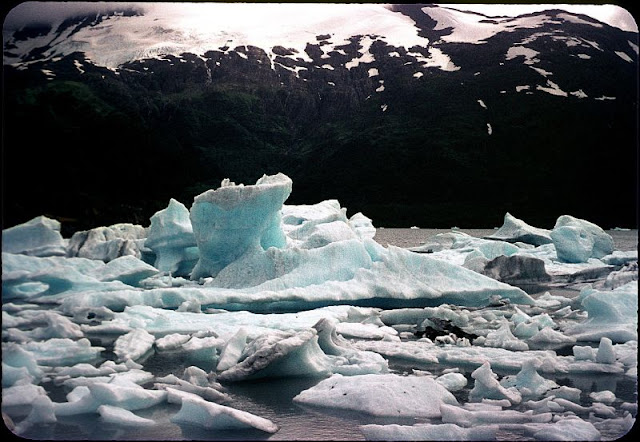
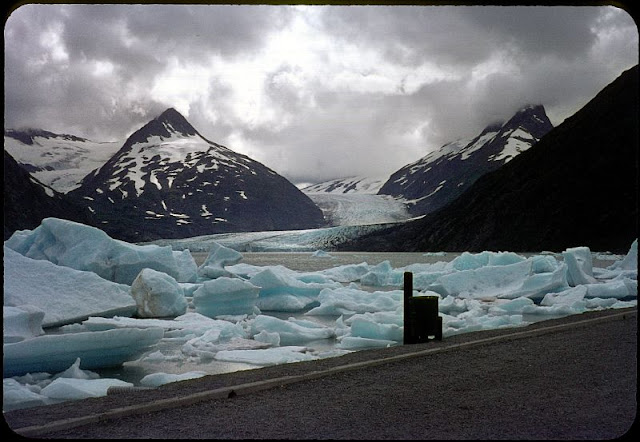
Portage Glacier, near Anchorage, Alaska, 1969

Portage Glacier, near Anchorage, Alaska, 1969

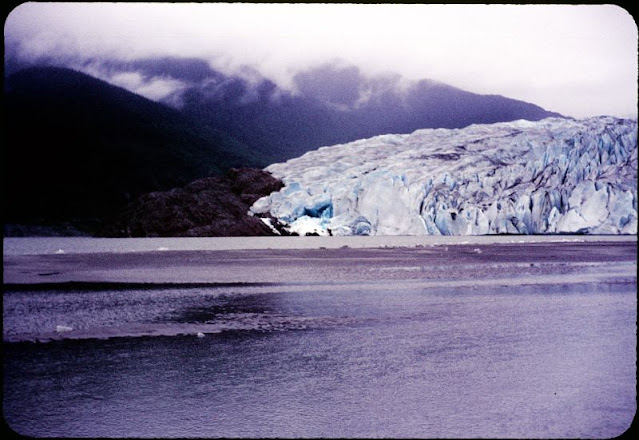
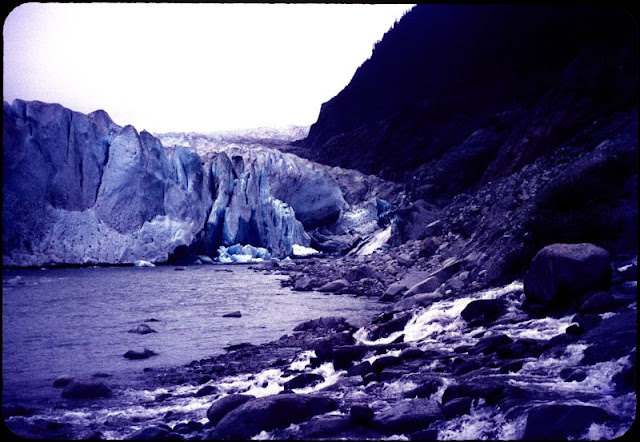
Mendenhall Glacier, near Juneau, Alaska, 1969

Mendenhall Glacier, near Juneau, Alaska, 1969

Mendenhall River, Alaska, 1969

17 Kasım 2020

Wonderful Life of an Alaska Family in the 1950s and ’60s Through Amazing Color Photos

Sand Point, also known as Popof Island, is a city in Aleutians East Borough, Alaska, United States. It is on northwestern Popof Island, one of the Shumagin Islands, off the Alaska Peninsula. It is the borough seat of Aleutians East Borough, and is near the entrance to the Bering Sea.

The Aleutians East Borough School District is in Southwestern Alaska along the Alaska Peninsula and Aleutian Chain The District was formed in 1988 from smaller districts that consolidated and formed a Borough with taxing authority.

The Borough and District boundaries are the same, and stretch over approximately 15,000 square miles (39,000 km2) of roadless, mostly treeless tundra, from the middle of the Alaska Peninsula to the north and east, going southwest out to Akutan just east of Dutch Harbor.

These amazing color photos from KurtClark that documented everyday life of his family mostly at Sand Point, Alaska in the 1950s and 1960s.

My mother with her friend Don May in Anchorage AK, about 1951. Her log home was at the corner of 9th and Gambell, circa 1951

Aunt Carol and uncle John in front of my grandparents' house in Spenard AK, circa 1954

1951 Chevrolet Deluxe behind my cousin Wendell in the driveway of my parents' home in City View neighborhood of Anchorage, July 1956

Anchorage road construction, circa 1956

Caption on back of slide: "Govt Hill and Snow", Anchorage, circa 1956

9 Kasım 2020

Wonderful Alaska Wilderness in the 1970s Through Dennis Cowals’ Lens

During August 1973 and August 1974, Dennis Cowals documented sites of the future Alaskan Pipeline both on the ground and from the air.

These wonderful photographs from The U.S. National Archives were taken by Dennis Cowals that document the pre-pipeline Alaska wilderness from Prudhoe Bay south to Valdez, the terminus of the pipeline.

Caribou Feed on Lichens and Moss. The Bird Is an Alaskan Raven, August 1973

"Alaska Cotton" Found in Marshy Areas Along Entire 789-Mile Route of the Pipeline, August 1973

A Pair of Young Rams, 3-5 Years Old, at the West Salt Lick of the Atigun Gorge, Four Miles From the Point Where the Pipeline Will Cross the Atigun River, August 1973

A Rainbow Seems Rooted in a Rock Wall That Forms the North Side of the Atigun Gorge, 5 Miles East of the Point Where the Pipeline Will Cross the Atigun River, August 1973

A Young Female Fox near Galbraith Lake Camp, August 1973

4 Şubat 2020

22 Amazing Photos Capture the Alaska Gold Rush in the Mid-1890s

Starting in the 1870s, prospectors trickled into the Yukon in search of gold. By 1896, around 1,500 prospectors panned for gold along the Yukon River basin—one of them was American George Carmack.

On August 16, 1896, Carmack, along with Jim Mason and Dawson Charlie—both Tagish First Nation members—discovered Yukon gold on Rabbit Creek (later renamed Bonanza Creek), a Klondike River tributary that ran through both Alaskan and Yukon Territory.

Little did they know their discovery would spur a massive gold rush.

The idea of striking it rich led over 100,000 people from all walks of life to abandon their homes and embark on an extended, life-threatening journey across treacherous, icy valleys and harrowing rocky terrain.

These amazing photos were taken by American photographer B. L. Singley that documented life of people during the Alaska Gold Rush around 1896-97.

The Dora Bluhm at the Port of Saint Michaels, Alaska

Group of Malamuts, Allenkaket, Alaska

Will Campbell, the Only White Boy on the Allenkaket River

Big Ice on the Allenkaket River, Alaska

Lowell Cabin, Beaver City, Alaska

24 Nisan 2019

Daily Life of Alaska in the Late 19th Century Through Amazing Photos

The Alaska, photographs collection is a set of 33 photographic prints, depicting various scenes in Alaska in such areas as Devil's Lake, Skagway, Miles Canon, Chilcoot Pass, Lake Bennet, and Sitka by an unidentified amateur, taken between 1896 and 1899, and held by the DeGolyer Library, Southern Methodist University.

Man with a Bicycle

Miles Canyon

Miles Canyon

On Chilcoot Tram, Between Canyon City and Sheep Camp

On Sixty- mile River, one mile above the Canyon

19 Haziran 2018

Extraordinary Running Aground in Alaska: Remarkable Images of the ‘Princess May’ on the Rocks at Lynn, 1910

Remarkable images of the steamship Princess May, resting at a seemingly impossible angle, after running aground on rocks in the Lynn Canal, Alaska on August 5, 1910. The passengers, crew and cargo (including a shipment of gold) were all evacuated safely.


The Grounding of the Princess May is one of the most famous shipwreck photographs in the world, after she ran aground in 1910 the photographs spread around the globe with startling speed and the stories of heroism on board began to emerge from the survivors.

On August 5, 1910, the Princess May departed from the port of Skagway in Alaska with 68 crew, 80 passengers aboard and a huge load of gold from Alaska’s booming gold rush. She was powering down the Lynn Canal at 10 knots through an impermeable fog when the hull hit an underwater reef off the north end of Sentinel Island. The ship’s weight and speed meant that it’s momentum drove it hard up onto the rocks, the reef tore through the hull and began flooding the engine room.


The Princess May was equipped with a wireless morse code transmitter however it had not been fitted with auxiliary batteries, meaning that if the engines stopped turning the dynamo, the power to the transmitter would be immediately lost. The wireless operator, W.R. Keller knew this, he was unable to transmit an SOS before power was lost to the ship and so he ran below decks and MacGyvered a functioning electrical connection with the engine room’s lamp battery, using this power he was able to send a short message that simply said “S.S. PRINCESS MAY SINKING SENTINEL ISLAND; SEND HELP.”

Largely as a result of this SOS message the ship was evacuated safely, W.R. Keller was revered as a hero and all aboard the Princess May were picked up by the Princess Ena.


Amazingly, less than a month later on September 3, 1910, the Princess May was refloated by a salvage crew and towed to port. In total, 120 steel plates along the hull had been damaged with the largest hole being over 50 feet (15 m) long. The ship was repaired at a (substantial at the time) cost of $115,000 USD and resumed her routes by spring 1911.

The Princess May remained in service for nine more years before she was sold to new owners, the Princess May Steamship Company in the Caribbean. In the end the vessel was scrapped and then scuttled off Kingston, Jamaica in 1930.

26 Nisan 2018

38 Beautiful Photos That Capture Everyday Life of Alaska From the 1950s and 1960s

These beautiful color photos from KurtClark were taken by his parents that documented everyday life of the family from the 1950s and 1960s. The cities includes Anchorage, and Sand Point.

My mother with her friend on the Harley in Anchorage, 1951

My aunt and uncle in front of my grandparents' house in Spenard, Anchorage, 1954

1951 Chevrolet Deluxe behind my cousin in the driveway of my parents' home in city view neighborhood of Anchorage, July 1956

 Anchorage road construction, circa 1956

Chevy sedan in Anchorage, 1956

23 Haziran 2017

Wonderful Alaska in the 1950s Through An American Couple's Lens

Joseph and Betty Hofman are an American couple who love traveling and documenting everyday life of people through their lenses. And theses wonderful Kodachrome slides they shot Alaska scenes when they were there in 1955.


22 Mayıs 2017

45 Photographs Document Everyday Life of Alaska From Between the 1880s and 1890s

A photo collection from SMU Central University Libraries depicting various scenes in Alaska in such areas as Devil's Lake, Skagway, Miles Canon, Chilcoot Pass, Lake Bennet, and Sitka in the late 1880s and 1890s.

A Study of Cattle at Sitka

By Indian River, near Sitka

Chilcoot

Court House at Sitka, Alaska

Custom House of U.S. at Mary Island, Alaska


FOLLOW US:
FacebookTumblrPinterestInstagram

CONTACT US


Browse by Decades

Popular Posts

Advertisement

09 10