Bring back some good or bad memories


ADVERTISEMENT

January 31, 2021

These Humorous Stinker Station Signs Helped to Provide Comic Relief for Motorists in Idaho During the 1950s and ’60s

When traveling to distant places, it is well to remember where you come from. If you come from Idaho, chances are you are familiar with the Stinker gas stations, which used to put up gag signs along the roads. Those bright yellow Stinker Station signs all with black print truly were an “Idaho only” institution. The Stinker gas stations used to break the monotony of traveling through southern Idaho’s miles of sagebrush with their comic signs.

Farris Lind was the genius behind Idaho’s iconic yellow road signs of the 1950s and 1960s. The signs were not only witty but captured nationwide attention.

After returning WWII, Lind had to figure out a way to compete with cut-throat Boise competition and he made his 16th and Front Boise service station world famous. He did it by scattering the yellow signs all over southern Idaho to wake up drivers bored with countless miles of sagebrush. One side advertised his 33-station Stinker Station empire, while the other side offered witty humor.

The most famous sign was near a field of lava rock, “Petrified watermelon. Take one home to your mother-in-law.” Lind got into the sign business by accident. In 1946, with the war behind him, he tried to buy exterior plywood to advertise his service station, but only interior plywood was available. That meant both sides had to be painted to preserve the wood. According to the Idaho Statesman, he was quoted saying, “As long as the backside of the sign was painted, I got the idea of putting humor or curiosity catching remarks on the back side”. One of the best signs is still standing outside of Idaho Falls. It says, “Warning to tourists: Do not laugh at the natives.”

As the signs increase you began to see the Stinker skunk on the edge of the sign. Then quickly the messages become a billboard advertising Stinker Cut-Rate Gas Station in Boise. The tourist was intrigued and compelled to come to the station for gasoline or, at the very least, an explanation of the advertising.

The signs became a sensation. Stinker Stations became the go-to fuel place in Boise and the surrounding area in Treasure Valley. Word about the signs began to spread as tourists brought their stories and pictures back with them. National newspapers (many used here) gave more attention to the signs. Lind was a hit. He expanded his empire to over 50 stores and business was stronger than ever. However, the same could not be said for Ferris Lind. Lind was diagnosed with polio in the 1950s and was bed-ridden for the majority of his life. He finally succumbed in 1983. The Lind family sold the business in 2002.

The roadside signs are a different story. While a few remain, many were removed  in 1965 when President Lyndon Johnson signed the highway beautification act. The act banned most commercial signs from rural highways and the Stinker landmarks were quietly removed. Stinker gas stations are still a staple of the region and employ more than 700 people.  The skunk is still their mascot, a fitting tribute to the original stinker, Fearless Farris Lind.


William Roentgen Demonstrates X-ray Machines at the Trans-Mississippi and International Exposition in Omaha, 1898

In the late 19th century, X-rays set America’s imagination ablaze. Only three years after its discovery by William Roentgen, the mysterious radiation went on display in this free-standing pavilion at the Trans-Mississippi and International Exposition of 1898 in Omaha, Nebraska.

Here, X-ray machines let attendees glimpse the interiors of everyday objects as well as their own bodies, blissfully unaware the devices were zapping them with 1,500 times as much radiation as contemporary X-ray machines. Even when their hair fell out, they embraced the rays as an early – and effective – depilatory.

The Collections of the Omaha Public Library

Early Cluster Bomb: The Molotov Bread Basket

The RRAB-3, nicknamed the Molotov bread basket (after Vyacheslav M. Molotov, the Soviet Foreign Minister) was a Soviet-made droppable bomb dispenser that combined a large high-explosive charge with a cluster of incendiary bombs. It was used against the cities of Finland during the Winter War of 1939–1940. The bomb consisted of a cylinder 2.25 meters (7.4 ft) long and 0.9 meters (3.0 ft) in diameter.


As it fell from an aircraft, a small turbine on the nose turned to release a spring loaded casing which, on opening, scattered 100 or more incendiary bombs; the main HE charge in the tail of the weapon continued to fall as a conventional bomb.

Other descriptions make no mention of a main charge and instead describe a large cylinder with vanes at the back that open out when the weapon is dropped. The vanes cause the bomb to spin and this has the effect of opening the sides and scattering the submunitions by centrifugal force.

Molotov diagram

In 1939, Vyacheslav Molotov claimed the Soviet Union was not dropping bombs on Finland, but merely airlifting food to starving Finns. The Finns were not starving, and they dubbed the RRAB-3 cluster bomb “Molotov’s bread basket.” They also named the improvised incendiary device that they used to counter Soviet tanks, commonly known as the Molotov cocktail, “a drink to go with the food.”

The Soviets had several versions: RRAB-1, RRAB-2, RRAB-3, with capacities of 1000, 500, and 250 kg respectively, each capable of holding various types of submunitions including HE, incendiary, and chemical.


Beach Life of the 1940s Through Vintage Found Photos

Swimwear of the 1940s, ’50s and early ’60s followed the silhouette mostly from early 1930s.Wartime production during World War II required vast amounts of cotton, silk, nylon, wool, leather, and rubber.

In 1942, the United States War Production Board issued Regulation L-85, cutting the use of natural fibers in clothing and mandating a 10% reduction in the amount of fabric in women’s beachwear. To comply with the regulations, swimsuit manufacturers produced two-piece suits with bare midriffs.

Women’s swimwear of the 1940s incorporated increasing degrees of midriff exposure. Teen magazines of late 1940s and 1950s featured similar designs of midriff-baring suits and tops.

Take a look at these vintage found photos to see what life looked like at the beaches during the 1940s.


30 Vintage Photos Capture Teenagers at Home in the 1970s

Back before the internet was even invented, teenagers in the 1970s also had many hobbies like today. They liked to hang out, party with friends, and especially go to bars and discos.

So what did they often do when at home? Made a call? Played guitar? Read a book? Just check out these vintage photos to see.


Amazing Photos of The Beatles Filming the Promotional Clip for “Strawberry Fields Forever” at Knole Park in Kent, 1967

The Beatles produced a promotional film clip for "Strawberry Fields Forever", which served as an early example of what became known as a music video. The film features reverse film effects, stop motion animation, jump-cuts from daytime to night-time, and the Beatles playing and later pouring paint over the upright piano.

By January 1967, Brian Epstein was under pressure from the Beatles’ record company to release a new single by the group. George Martin told him that they had recorded “Strawberry Fields Forever” and “Penny Lane”, which, in his opinion, were “two all-time great songs.” The decision was made to issue them as a double A-side single, a format the Beatles had used for their previous single, “Eleanor Rigby” / “Yellow Submarine”, in August 1966. The Beatles produced a film clip for “Strawberry Fields Forever”, in a continuation of their policy since 1965 of avoiding the need to promote a single with numerous personal appearances on television. It was filmed on January 30 and 31, 1967 at Knole Park in Sevenoaks, Kent. The following week, the band shot part of the promotional film for “Penny Lane” at the same location.

The clip was directed by Peter Goldmann, a Swedish television director who had drawn inspiration in his work from Richard Lester’s style in the Beatles’ 1964 film A Hard Day’s Night. Goldmann was recommended to the Beatles by their mutual friend Klaus Voormann. One of the band’s assistants, Tony Bramwell, served as producer. Bramwell recalls that, inspired by Voormann’s comment on hearing “Strawberry Fields Forever” – that “the whole thing sounded like it was played on a strange instrument” – he spent two days dressing up a large tree in the park to resemble “a piano and harp combined, with strings.”

Instead of a performance of the song, the clip relies on abstract imagery and features reverse film effects, long dissolves, jump-cuts including from day- to night-time, superimposition and extreme close-up shots. The Beatles are shown playing and later pouring paint over the upright piano; at one point, McCartney appears to leap from the ground onto a branch of the tree.

In his commentary on the promo clip, music critic Chris Ingham writes: “Beautifully and spookily lit … much attention is given to close-ups of The Beatles’ faces and facial hair, as if the viewer is invited to contemplate the significance of the newly furry Fabs. There’s an appropriately surreal air about the film … which, when experienced simultaneously with The Beatles’ extraordinary new music, is deliciously disorientating. The final scene of The Beatles pouring pots of colored paint onto the “piano” is oddly shocking, but brilliantly memorable as a statement of iconoclastic artistic intent.”


January 30, 2021

Panasonic MC-1000, the Very First Plastic-Bodied Vacuum Cleaner From 1965

It’s a Car! It’s a Toy! It’s a Vintage Spaceship!

Before the mid-1950s, vacuum cleaners weren’t in many Japanese homes because dusters, brooms, and floor cloths were considered adequate for cleaning traditional Japanese homes. But through extensive marketing efforts by manufacturers, Japanese-made vacuum cleaners gradually became household necessities by the 1960s – with the Panasonic MC-1000 top of the list.


Using the material of the moment – plastic – the MC-1000 was a world away from the typical, functional-looking cylindrical vacuum cleaners made from metal sheeting. Making the most of plastic’s versatile shaping potential, its elegantly flowing, curved surfaces define the aesthetics of plastic. Plastic was responsible for more than just its good looks, though – unlike vacuum cleaners constructed of sheet metal, whose machine parts had to be inserted in predetermined order, the MC-1000’s body was made of left and right pieces that simply screwed into place. Productivity was greatly increased as a result of this method, made possible by its pioneering use of plastic.

This elegant, streamlined vacuum cleaner won awards, made vacuuming easier than ever before, and ushered in the new plastic era. The first plastic-bodied vacuum cleaner, its unique front wheel gave it effortless maneuverability, making vacuuming less stressful than ever before. This bold, modern product heralded the era of plastic and set a record for vacuum cleaner production, with an astonishing 630,000 units manufactured.

Mesmerizing Portraits of Theda Bara, Hollywood’s Original Vamp

Theda Bara (1885-1955) was a popular actress in the silent film era and one of the early sex symbols of the silver screen. After her appearance as a vampire in A Fool There Was (1915), she quickly attracted attention from both male and female audiences. Between 1915 and 1919, Bara was Fox studio’s biggest star, playing a large number of femme fatale roles, which earned her the nickname “The Vamp” and helped popularize the “vamp” characters. At the peak of her fame, she earned $4,000 per week. 


Bara made more than 40 films between 1914 and 1926, but most were lost in the 1937 Fox vault fire. She retired from acting in 1926, never appearing in a “talkie.” Take a look back at the sultry actress through 29 mesmerizing portraits from the 1910s to 1920s below: 


40 Glamorous Photos of Frances Dee in the 1930s and ’40s

Born 1909 in Los Angeles, California, American actress Frances Dee began working as a movie extra as a lark. Her big break came when, still an extra, she was offered the lead opposite Maurice Chevalier in Playboy of Paris (1930).


Dee starred in the film An American Tragedy (1931). She is also known for starring in the 1943 Val Lewton psychological horror film I Walked With a Zombie.

Dee’s additional screen credits included June Moon, Little Women, Of Human Bondage, Becky Sharp, and Payment on Demand. She co-starred with her husband Joel McCrea in the Western Four Faces West (1948).

Dee was honored at the 1998 Memphis Film Festival in Mississippi. In 2004, Frances Dee McCrea died in Norwalk, Connecticut due to complications from a stroke at the age of 94.

Take a look at these glamorous photos to see the beauty of Frances Dee in the 1930s and 1940s.


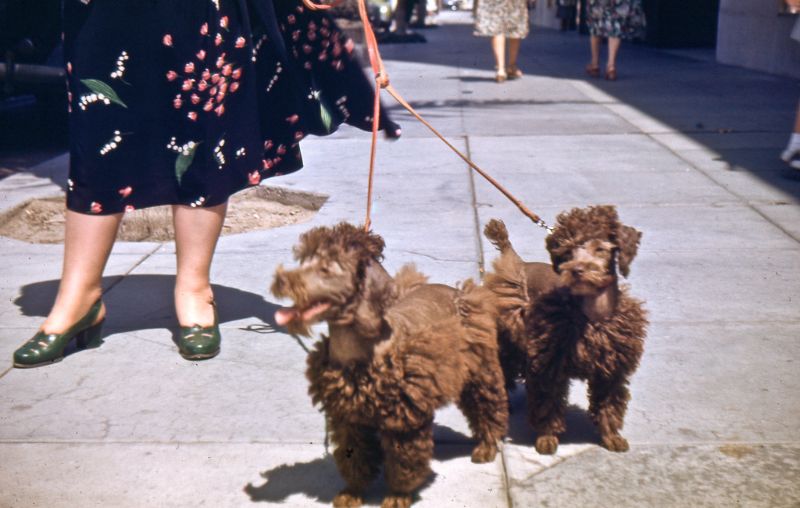
40 Cool Photos Capture People With Their Poodles in the 1950s and ’60s

The Poodle is a dog breed that comes in three varieties: Standard Poodle, Miniature Poodle, and Toy Poodle. The breed’s origin is disputed: whether it descends from Germany as a type of water dog, or from the French Barbet.


Ranked second most intelligent dog breed just behind the Border Collie, the Poodle is skillful in many dog sports and activities, including agility, obedience, tracking, herding, circus performance, and assistance dogs. They are recorded as the seventh most popular dog breed in the United States.

A set of cool vintage photos that shows people with their poodles in the 1950s and 1960s.


January 29, 2021

Found Photographs From a Zeta Tau Alpha Recruitment’s Party in the 1950s

Zeta Tau Alpha recruitment week almost always has a theme, hence explaining the Wizard of Oz costumes and decor; this also explains all of the alum in the photos. There are always alum around during recruitment and it is courteous of current members to give up their seats for alum and sit on the ground. Many times, alum help to prep current members for the parties they will host with new members.

Also, there are typically one to two days during recruitment when sororities preform skits for potential new members (then called rushees), which could explain the girls in top hats and maybe some of the Wizard of Oz costumes. One of the photos depicts many of the women on the steps of the sorority house who appear to be singing. Door chants are common during recruitment and are/were often preformed as depicted. All of the members would stand either inside or outside the house to do a chant on behalf of the sisterhood for new members before mixers/parties. Also, it is customary to wear whites and do door chants on bid day – the day where new members receive cards extending an invitation to become a member of the sorority.

The recruitment happens at the beginning of the school year when women who have decided they want to join a sorority go through the houses on the campus to find which group of girls they fit in with best. In recruitment, their outfits are usually similar. Men are of course not a part of recruitment, as the goal is to find a sisterhood.


FOLLOW US:
FacebookTumblrPinterestInstagram

CONTACT US


Browse by Decades

Popular Posts

Advertisement

09 10