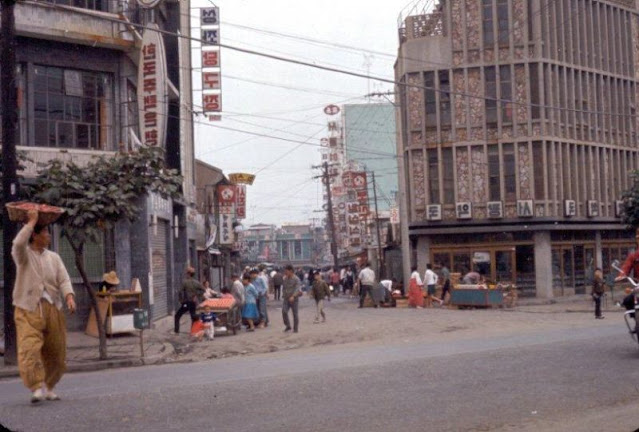
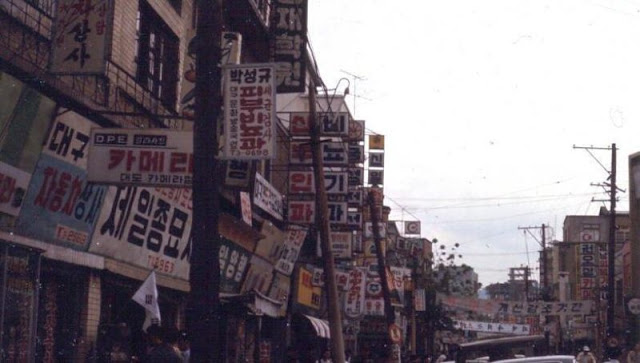
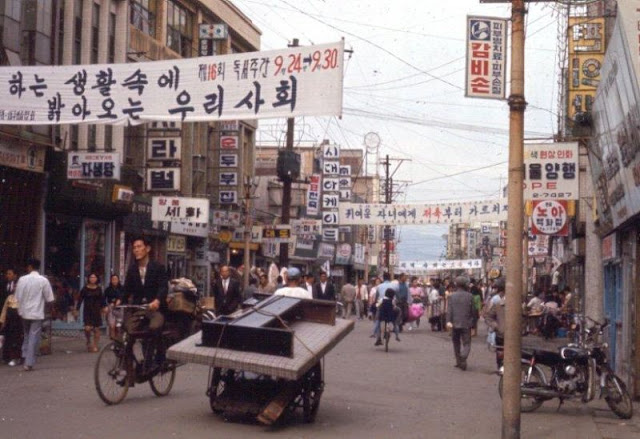
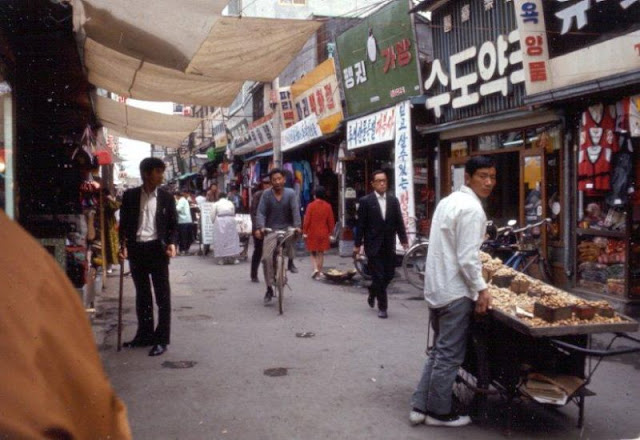
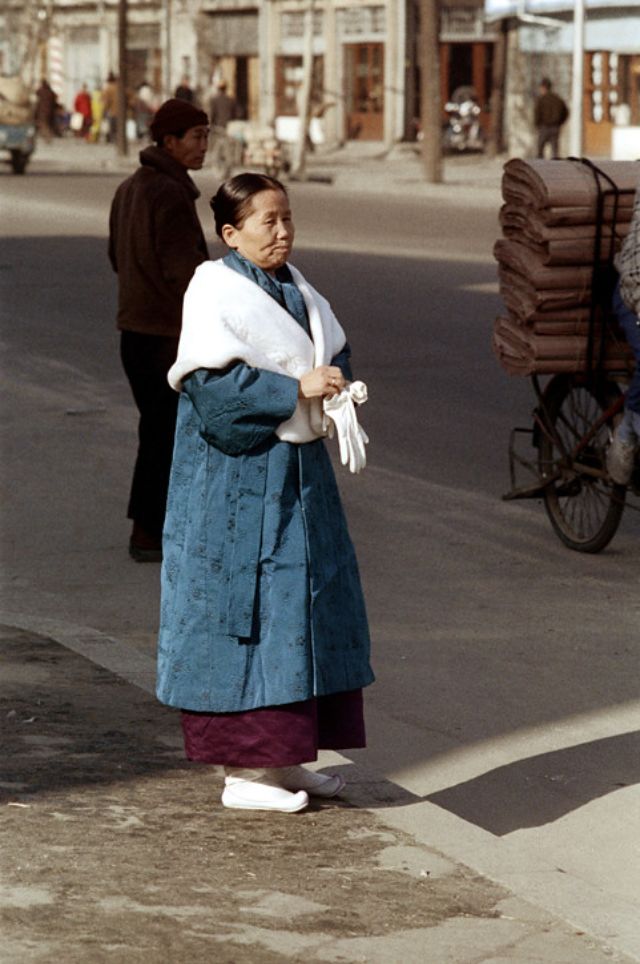
Bring back some good or bad memories


ADVERTISEMENT
Showing posts with label South Korea. Show all posts

June 21, 2026

Jayne Mansfield Visiting Camp Casey in Korea, 1957

In late 1957, Jayne Mansfield took a USO-style break from her filming schedules to tour US military bases in South Korea, including Camp Casey (home of the 7th Infantry Division at the time). True to her larger-than-life “blonde bombshell” persona, she brought total Hollywood glamour to the sub-zero Korean winter.


While the soldiers were bundled up in heavy olive-drab parkas to combat the biting cold, Mansfield famously braved the elements in her signature form-fitting sweaters, high heels, and occasionally a bright coat with a fur collar. It made for some of the most striking, surreal press photographs of the era.

To visit the more remote outposts like Camp Casey, which were located quite close to the Demilitarized Zone (DMZ), she was flown around in US Army H-19 or H-21 helicopters, often posing playfully with the pilots and ground crews.

Following in the footsteps of Marilyn Monroe’s legendary 1954 troop tour, Mansfield’s visit was a massive event for the thousands of soldiers stationed in Korea post-armistice. She signed endless autographs, shared meals with the troops in the mess halls, and put on lively shows that packed out the base amphitheaters.

August 19, 2025

Vintage Photos From the Bob Hope Show in Korea in 1950

The Bob Hope Show in Korea in 1950 was one of the earliest USO tours during the Korean War. Legendary comedian Bob Hope, already famous for entertaining American troops in World War II, brought his signature humor, music, and variety acts to soldiers stationed in Korea.

His shows featured comedy routines, musical performances, and guest stars, all aimed at lifting morale during the difficult early months of the conflict. This Bob Hope USO show was staged in Wonsan, Korea on October 24, 1950.


November 16, 2023

28 Wonderful Color Photos Captured Everyday Life of Busan in the Early 1950s

Busan is South Korea’s second most populous city after Seoul. It is the economic, cultural and educational center of southeastern South Korea, with its port being South Korea’s busiest and the sixth-busiest in the world. The surrounding “Southeastern Maritime Industrial Region” (including Ulsan, South Gyeongsang, Daegu, and some of North Gyeongsang and South Jeolla) is South Korea’s largest industrial area.

Busan is divided into 15 major administrative districts and a single county. The most densely built-up areas of the city are situated in a number of narrow valleys between the Nakdong and the Suyeong Rivers, with mountains separating most of the districts. The Nakdong River is Korea’s longest river and Busan’s Haeundae Beach is also the country’s largest.

These wonderful color photos from m20wc51 that captured everyday life of Busan around 1951.


September 21, 2023

Vintage Photos of the 58th Fighter Bomber Group Show at Osan Air Base, 1956-57

Osan Air Base is a United States Air Force (USAF) and Republic of Korea Air Force (ROKAF) base located near Songtan Station in the city of Pyeongtaek, South Korea, 64 km (40 mi) south of Seoul.

Despite its name, Osan AB is not within Osan City, which is 7.5 km (4.7 mi) to the north. The base is the home of the headquarters for Seventh Air Force, Pacific Air Forces’ 51st Fighter Wing, and a number of tenant units. The base is also the headquarters of the Republic of Korea Air Force (ROKAF) Operations Command.

Osan Air Base is also the departure and arrival point for U.S. government-contracted “Patriot Express” flights bringing service members and their family members to South Korea from Seattle-Tacoma International Airport in the U.S. state of Washington, Misawa Air Base and Yokota Air Base in Japan.

A small photo set of the 58th Fighter Bomber taken during a show at Osan Air Base, Korea in 1956-57, by an unknown photographer. The 58th Fighter Bomber consisted of the 69th FBS, the 310th FBS, and the 311th Fighter Bomber Squadron. They were first based in Daegu, and later at Osan Air Base.


January 2, 2023

Great Men of Korea Ride Safely One Wheel, 1933

Riding on one wheel may convey an impression of reckless driving, but it is a slow and stately form of locomotion in the Asiatic land of Chosen (Korea). When a dignitary prepares for a trip, he dons a costume that properly reflects his power and prestige, and mounts a vehicle like the curious single-wheeled carriage pictured here. Four strong coolies seize the guiding bars and trundle him toward his destination. Judging from appearances the passenger must necessarily be resigned to a certain amount of rather rough joggling.

General of Korea, attired in full dress for formal visit, goes forth riding on a one-wheeled carriage that is propelled by his servants.

August 12, 2022

30 Fascinating Photographs That Capture Everyday Life in South Korea in the 1980s

The decade of the 1980s is rightly celebrated by Koreans today as the era of minjung (people’s) culture, a time when a collective effort by ordinary citizens and intellectuals alike led to upheaval and the democratization of the country within the space of a few years.

Previous representations of the era, however, have tended to privilege a political narrative of liberation over many complexities and contradictions. On the one hand, the focus on democratization has left in the shadow other coeval processes such as rapid economic expansion, the rise of a middle class as a social subject, and the opening up of culture through new media and technology.

On the other hand, the persistent centering of minjung intellectuals as the agents of democratization has led to a neglect of the contributions of workers, women, and common Koreans as well as the downplaying of the international aspects of the movement.

These vintage photographs below captured the life of South Korea through the 1980s:


June 1, 2022

30 Vintage Photographs of South Korean Weddings From the 1950s

Marriage in Korea mirrors many of the practices and expectations of marriages in other societies.

Traditional wedding attire for grooms was samogwandae, which refers to the uniforms of government officials of Joseon. It consisted of a samo (black gauze hat), dallyeong (robe with a round neckband) and mokhwa (black boots). The hyungbae (insignia embroidered on the breast and back of the robe) and gakdae (lit. square belt) differed depending on the official’s rank, but this did not apply to the groom, and he could wear the hyungbae and gakdae of his choice regardless of rank and whether or not he had a government position. When the groom entered the daeryecheong (an outdoor banquet hall for a wedding), he held a saseon (square fan with two handles) with both hands to cover his face.

Traditional wedding attire for brides was called noguihongsang (lit. green top and red skirt), and consisted of a crimson skirt and either a green or yellow jeogori (top) over a pink inner garment. The bride also put on either a hwarot (wedding overcoat) and hwagwan (flower crown) or a wonsam (ceremonial robe) and jokduri (crown-like headpiece). The crimson skirt was a staple, but the color of the jeogori and type of robe and headpiece differed in each family.

An essential part of a wedding ceremony is hair and make-up. The bride powdered her face, put rouge on her lips, and put a red rouge spot on her cheeks and forehead. She either wore a ga, a big wig made of braided hair) or put her hair up in a chignon and fixed it with a binyeo (ornamental hair rod) adorned with a dragon pattern or plum blossoms and bamboo leaves. A daenggi (ribbon) was attached to each side of the binyeo, and a jokduri or hwagwan placed on top of the head with a long piece of the ribbon hanging down from the headpiece.

The bride’s wedding garments were sent by the groom’s family, but at times it was also provided by the bride’s family or borrowed from someone in the village. The representative bridal wear was won-sam, especially the green wonsam, which was traditionally the ceremonial dress of princesses. The robe has very wide color striped sleeves with han-sam (sleeve extensions attached at the end to completely cover the hands).

After Korea opened its ports to foreign trade, Western wedding customs were introduced and spread among the intelligentsia and Christians in the big cities. Grooms began wearing tailcoats while brides wore a white jeogori and skirt with a veil over the face, which was a blend of traditional and modern bridal attire. But during the Japanese colonial period (1910-1945) and the Korean War (1950-1953) and the aftermath, people could not afford formal wedding attire due to dire economic conditions, and in many cases, brides had to make do with a skirt and jeogori and a cloth covering the hands.


May 2, 2022

45 Photographs Capture Street Scenes of Seoul, South Korea in the 1980s

The 1980s were an exciting time to be in booming Seoul, with Koreans and expat English teachers alike hustling for a better economic life.

Everyone was looking forward to the 1988 Summer Olympics, the first professional baseball game was played in the old Dongdaemun Stadium on a cold blustery day in March 1982, and the bane of dictatorship was relegated to the dustbin of history after a fair and honest presidential election was held in December 1987.

With dictatorship finally gone, South Koreans could get a passport and travel abroad. Seeing the world was something that they had dreamed of doing and then did with a vengeance. And they passed their wanderlust on to the following generations, with today’s young Koreans being some of the most-traveled students in the world.

Here, a gallery of 45 amazing photographs that show what life in Seoul looked like in the 1980s:


April 10, 2022

Stunning Black and White Photos of a New Seoul From 1956 to 1963 by Han Youngsoo

During his lifetime, Han Youngsoo (1933–1999) was little known outside of Korea. Born to a well-to-do family in Gaesung, Korea, Youngsoo took drawing and painting lessons as a young man and pursued photography as a hobby. After taking part in bitter frontline fighting as a young South Korean soldier during the Korean War (1950–53), he returned to Seoul at the war’s end and found a devastated, impoverished city. Choosing photography as a profession, Youngsoo witnessed a period of profound transformation in Seoul that saw the rapid creation of a modern city and urban society.

Youngsoo’s photographs tell this story by offering a fascinating window onto the everyday lives of the city’s ordinary men, women, and children. Although he did not overlook the surviving customs and architecture of old Seoul, Youngsoo was more interested in exploring the modern urban culture that was rapidly taking shape. He also paid special attention to the changing status of Korean women, who were then finding new roles as entrepreneurs or consumers, as suggested in his views of narrow streets lined with well-stocked fashion boutiques.

“The war had taken away many things,” wrote Youngsoo. “Not only had it mercilessly trampled down on our beloved families and neighbors, but also their happiness, hope, and furthermore humanity itself. As if that wasn’t enough, by the end it had utterly destroyed everything on the face of the earth leaving behind ruins, despair, famine and sorrow.”

Take a look at the city as it rebuilt itself after the war through these 33 stunning black and white photographs taken by Youngsoo:

Seoul

Seoul

Seoul

Seoul

Seoul

January 12, 2022

Vintage Photos Capture Street Scenes of Taegu in the Early 1970s

Daegu, formerly spelled Taegu, is a city in South Korea. It is the third-largest urban agglomeration in Korea after Seoul and Busan; the third-largest official metropolitan area in the nation; and the second-largest city after Busan in the Yeongnam region in southeastern Korean Peninsula.

Daegu is located in south-eastern Korea about 80 km (50 mi) from the seacoast, near the Geumho River and its mainstream, Nakdong River in Gyeongsang-do. The Daegu basin is the central plain of the Yeongnam region.

Daegu was an economic motor of Korea during the 1960s–1980s period and was especially known for its electronics industry. The humid subtropical climate of Daegu is ideal for producing high-quality apples, thus the nickname, “Apple City”. It is also known as “Textile City”. Textiles used to be the pillar industry of the city.

These photos were taken by DRC from May 1970 to June 1971 when he served in the United States Army stationed at Camp Walker in Tague.

Downtown Tague, 1970-71

Downtown Tague, 1970-71

Downtown Tague, 1970-71

Downtown Tague, 1970-71

Downtown Tague, 1970-71

June 1, 2021

Seoul in the Early 1970s Through Amazing Photos

Seoul is the capital and largest metropolis of South Korea. It forms the heart of the Seoul Capital Area with the surrounding Incheon metropolis and Gyeonggi province.

From the 1960s - 1970s, Seoul experienced serious urban issues, such as traffic congestion, environmental pollution, formation of illegal settlement areas, and housing shortages, as a result of the extensive population inflow and lack of social infrastructure. To resolve these issues, the Seoul Metropolitan Government focused on establishing a basic infrastructure by expanding roads, building apartment complexes in illegal settlement areas, and constructing the Cheonggye Overpass and Yeouido Island.

Considered to be a global city, Seoul was the world’s 4th largest metropolitan economy in 2014 after Tokyo, New York City and Los Angeles. In 2017, the cost of living in Seoul was ranked the 6th highest globally.

These amazing color photos from nick dewolf photo archive documented everyday life of Seoul in 1972.


May 21, 2021

50 Wonderful Vintage Photographs That Capture Street Scenes of Seoul in the 1970s

Seoul was established as the national capital of the Joseon Dynasty in 1392, and it has continued to maintain its status ever since. However, the city was completely destroyed during the Korean War (1950–1953). Because of the war, Seoul became unprecedentedly overpopulated by people who came to the city for jobs and war refugees who escaped North Korea.

Shortly thereafter, South Korea experienced rapid economic development, becoming one of the four Asian Tigers. Currently, South Korea is among the top 10 nations in terms of the economic size. Moreover, its popular culture called the “Korean wave,” has become popular and is enjoyed by youth globally.

Seoul has also become an international hub that is home to about 10 million people. The Seoul Capital Area (Seoul Metropolitan Area), which includes Seoul City, is the most important geographical area in South Korea because more than half of the country's population resides there.

As a result of these sweeping changes, much of what was photographed below no longer exists.


FOLLOW US:
Facebook • Tumblr • Pinterest • Instagram

CONTACT US


Browse by Decades

Popular Posts

Advertisement

09 10